

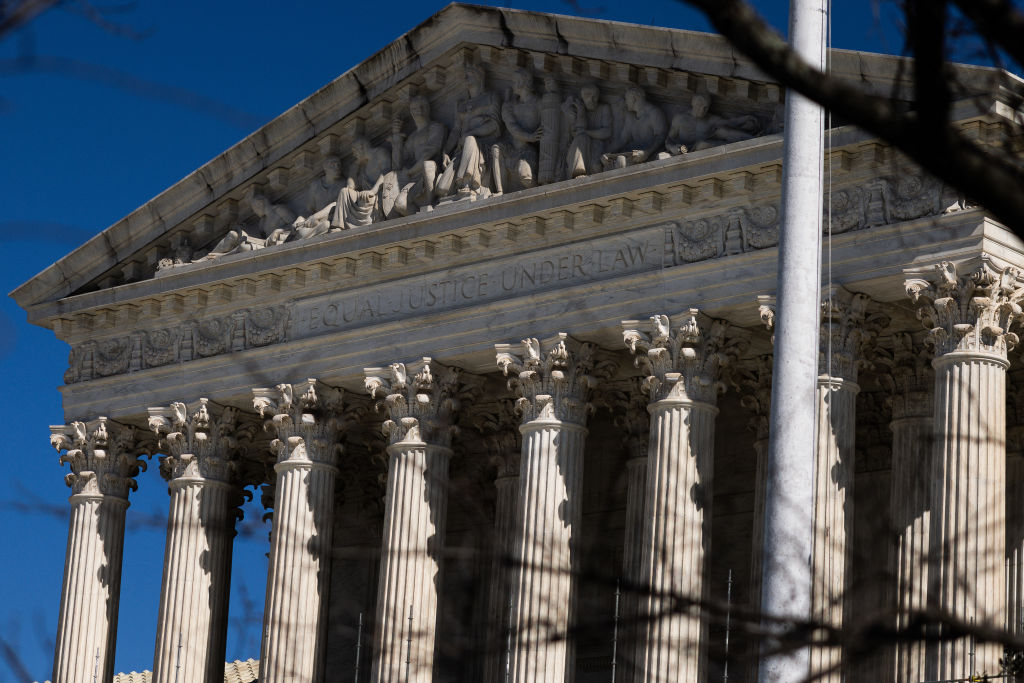
On Monday, Dec. 1, in Urias-Orellana v. Bondi, the Supreme Court will consider the federal judiciary’s role in asylum cases as it weighs whether a federal court of appeals must defer to the Board of Immigration Appeals’ judgment on an asylum seeker’s claims of persecution when it reviews the individual’s case.Â
The question was brought to the justices by lawyers for Douglas Humberto Urias-Orellana, Sayra Iliana Gamez-Mejia, and their minor child, who are seeking asylum protections available under the Immigration and Nationality Act. The family fled to the United States from El Salvador in 2021 after facing repeated threats of violence from a hitman, or sicario, working for a drug lord. The sicario and others appeared to be tracking their efforts to relocate within the country, and had shot two of Urias-Orellana’s half-brothers in the past after one of the half-brothers, Juan, got into an argument with the sicario “over a romantic relationship between the sicario’s mother and Juan’s father,†according to the family’s petition to the Supreme Court. The men had demanded money from Urias-Orellana and, during one confrontation, hit him three times in the chest.
As part of the process of seeking asylum, the family appeared before an immigration judge, who considered whether they qualified as refugees under the INA. A refugee, according to that law, is someone who has fled a country “because of persecution or a well-founded fear of persecution on account of race, religion, nationality, membership in a particular social group, or political opinion.†Urias-Orellana contended that his family fit that definition because they were threatened due to their association with his half-brother, Juan, who is part of their social group.
The immigration judge denied the family’s request for asylum, finding that what they experienced did not satisfy the law’s definition of persecution or fear of persecution. Among other issues raised by the judge was the fact that the threats of violence against Urias-Orellana had only once led to a physical altercation.
The family appealed to the Board of Immigration Appeals, “the highest administrative body for interpreting and applying immigration laws.†It, too, denied the family’s asylum claims, upholding the immigration judge’s persecution determination and removal order.
Under the INA, asylum seekers who have been denied relief by the Board of Immigration Appeals have a right to ask a federal court of appeals to review their case. However, the courts of appeals do not agree on what type of review they’re allowed to conduct when it comes to persecution claims. Some have held that they can review de novo, or from scratch, the board’s determination that the asylum seeker’s alleged experiences do not rise to the level of persecution required under the INA, while others have held that they must defer to the board’s determination unless “any reasonable adjudicator would be compelled to conclude to the contrary,†as the U.S. Court of Appeals for the 1st Circuit put it when it upheld the board’s decision.Â
The family emphasized this circuit split when they asked the Supreme Court to hear their case. In his response to the petition, U.S. Solicitor General D. John Sauer agreed that “the circuits are inconsistent in their approaches to the question presented, which is important and frequently recurring†and concluded that the court should grant the petition. The justices did so in June.
In their brief on the merits, the family urged the Supreme Court to side with the courts of appeals that have undertaken an independent review of “whether the mistreatment endured by a noncitizen meets the legal standard for ‘persecution,’†contending that, if lawmakers wanted to prevent such a review, they could have used “express language requiring deference†to the Board of Immigration Appeals, as they do for other “administrative decisions†concerning the INA. The family added that requiring such deference “would effectively resurrectâ€Â Chevron v. Natural Resources Defense Council – a 1984 case requiring courts to defer to federal agencies’ interpretations of ambiguous laws that the court overturned last year – “in asylum cases.â€
The family further argued that allowing federal courts of appeals to independently determine whether an asylum seeker’s experience satisfies the INA’s definition of persecution will “help ensure fair and consistent application†of that law and foster “the development of clear legal rules that will streamline asylum-eligibility decisions.†By comparison, requiring deference to the Board of Immigration Appeals “invites inconsistent and incorrect results, often with life-threatening consequences.â€Â
Sauer countered that such an approach would not promote consistency, but would, instead, “mire the courts of appeals in inherently factual work for which they are ill-suited.†Worse, he continued, it would go against Congress’ determination that “the best way to promote uniformity and efficiency in asylum determinations†is to leave it to federal officials to make persecution determinations “with limited judicial review.â€Â
Sauer rejected the family’s claims about the text of the INA being ambiguous, contending that persecution determinations are “primarily factual†and are thus covered by the law’s statement that “administrative findings of fact are conclusive unless any reasonable adjudicator would be compelled to conclude to the contrary.†“[D]eterminations that an applicant failed to show persecution … turn on assigning weight to evidence, drawing inferences, making credibility determinations, and balancing a multitude of facts. Congress entrusted that task primarily to the agency with expertise and long experience considering factual allegations of persecution,†Sauer argued.
Cases: Urias-Orellana v. Bondi
Recommended Citation:
Kelsey Dallas,
Supreme Court to consider federal courts’ role in asylum cases,
SCOTUSblog (Nov. 25, 2025, 9:30 AM),
https://www.scotusblog.com/2025/11/supreme-court-to-consider-federal-courts-role-in-asylum-cases/