

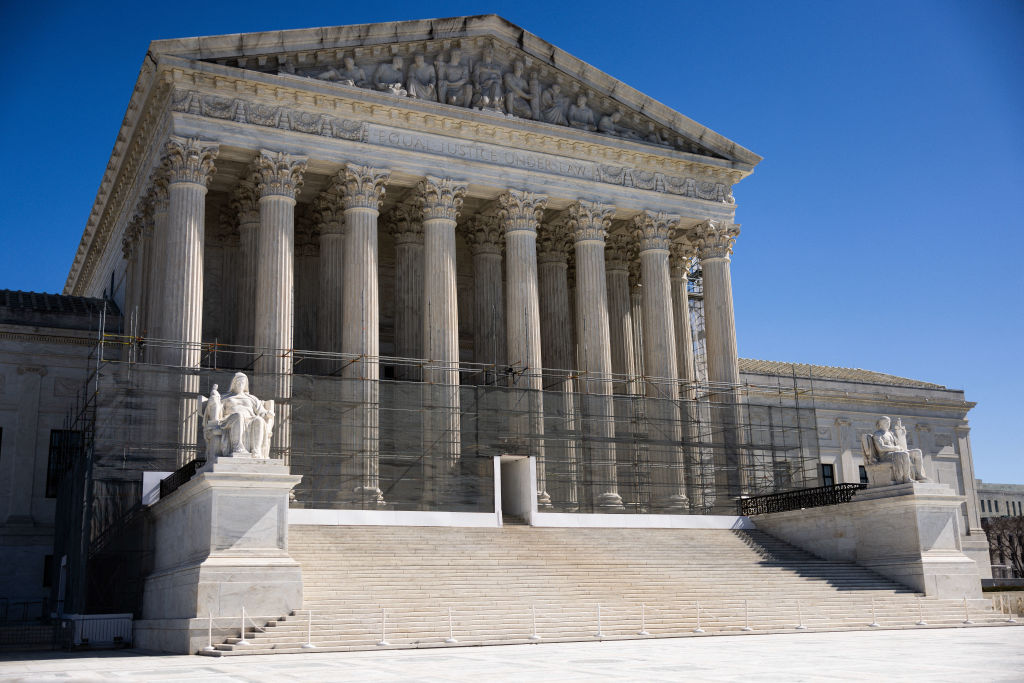
The Supreme Court on Tuesday morning turned down a plea from conservative media personality Alex Jones to hear his appeal of a Connecticut case brought by families of the children killed at Sandy Hook Elementary School more than a decade ago, in which he was found liable for defamation and emotional distress. The court also rejected an appeal by several Colorado parents, who contend that a school district in that state violated their constitutional rights when they excluded them from discussions of their children’s gender identity.
The announcements came as part of a list of orders released by the Supreme Court from the justices’ private conference on Oct. 10. The court granted one new case, Hunter v. United States, from that conference on Friday afternoon; Tuesday’s order list did not add any additional cases to its oral argument calendar for the 2025-26 term.
Kelsey Dallas has more on the Alex Jones case in an earlier post for SCOTUSblog.
In Lee v. Poudre School District R-1, the justices declined to weigh in on a lawsuit against a Colorado school district by parents who allege that the district violated their constitutional rights by interfering with their parental decision making. Specifically, the parents contended that the school district’s policies “exclude parents from the conversation of their child’s gender identity by, inter alia, actively discouraging disclosure of such information by school officials†and “sowing doubt in the minds of students regarding the trustworthiness of their parents†– by, for example, telling students not to tell their parents what they discuss at an after-school group that addresses gender and sexuality, and by directing school staff to use a student’s preferred name and pronouns with the child, but the child’s birth name and pronouns with the parents. “This secrecy and concealment toward parents whose children discuss topics related to gender identity at school creates division within the parent-child relationship and undermines the trust essential to a family’s foundation,†the parents said.
A federal district court ruled for the school district, concluding that the parents had not shown that the school district had an official policy that caused the parents’ alleged injury. The U.S. Court of Appeals for the 10th Circuit upheld that decision.
On Monday, the court denied the parents’ petition for review. Justice Samuel Alito, joined by Justices Clarence Thomas and Neil Gorsuch, penned a statement regarding the decision to deny review. Alito wrote that he agreed with the court’s decision because the parents had not challenged “the ground for the ruling below.†“But I remain concerned,†Alito added, “that some federal courts are ‘tempt[ed]’ to avoid confronting a ‘particularly contentious constitutional questio[n]’: whether a school district violates parents’ fundamental rights ‘when, without parental knowledge or consent, it encourages a student to transition to a new gender or assists in that process.’†“The troubling—and tragic—allegations in this case underscore the ‘great and growing national importance’ of the question that these parent petitioners present,’†he concluded.
The justices denied review without comment in Doe v. Grindr, in which the court had been asked to weigh in on the scope of Section 230 of the Communications Decency Act, which gives websites and online platforms immunity from lawsuits arising from content posted by their users, and for their moderation of content.
The question comes to the court in a lawsuit brought against Grindr, a dating app that is popular with bisexual and gay men, by an anonymous plaintiff, known only as John Doe. Doe contends that when he was 15, Grindr offered him a membership and recommended him to adults for sex, and that he was then raped by four adults over four days.
A federal court in California dismissed Doe’s case. U.S. District Judge Otis Wright acknowledged that the facts of Doe’s case were “indisputably alarming and tragic,†but he concluded that they were barred by Section 230. Although Doe “seeks to hold Grindr liable for the design, development, and sale of a defective product,†Wright wrote, in fact “Doe’s claims seek to hold Grindr liable based on its publishing of user content.â€
When the U.S. Court of Appeals for the 9th Circuit upheld that ruling, Doe came to the Supreme Court, asking the justices to take up his case. “This abdication of responsibility by platforms is exactly what Congress enacted Section 230 to prevent, yet it has turned into a license to unleash harm in the name of profit,†he argued.Â
In Humphreys v. Emmons, the justices denied review in a death penalty case based on a murder and robbery in which a juror told the court before the trial began that she had been the victim of an attempted rape and robbery but swore that she could nonetheless be a fair juror. While the jury was deliberating whether to impose the death penalty, however, she told the other jurors that she had been assaulted while naked in her bed, and jurors later reported that she “had her mind made up from day one†of the trial. Jury deliberations eventually “almost completely broke down,†and the jury eventually returned a death sentence.
Although testimony and affidavits about the juror’s conduct later came to light, Georgia law generally bars the use of testimony by jurors to undermine a verdict. When the defendant raised the issue in an effort to overturn his sentence, the federal courts rejected his claim under federal post-conviction law, and the Supreme Court denied review.
Justice Sonia Sotomayor, joined by Justices Elena Kagan and Ketanji Brown Jackson, dissented from the denial of review. In Sotomayor’s view, the Supreme Court should have sent the case back to the U.S. Court of Appeals for the 11th Circuit for it to clarify the grounds for its decision. “In a capital case with a potentially meritorious juror-misconduct claim,†she wrote, “mere confusion about a lower court’s reasoning does not justify closing the door to relief altogether.†“Tragically,†she continued, “the Court denies review instead, allowing a death sentence tainted by a single juror’s extraordinary misconduct to stand.â€
In Thomas v. Humboldt County, California, the court rebuffed an appeal from California property owners who challenged the county’s failure to provide them with a jury trial before imposing fines for alleged violations of county codes relating to growing cannabis – even though, the property owners say, none of them actually ever grew cannabis. The lower courts dismissed their claim under the Seventh Amendment to the Constitution, citing the Supreme Court’s 1916 ruling in Minneapolis & St. Louis Railroad Co. v. Bombolis, holding that the Seventh Amendment right to a jury trial does not apply to the states. The property owners then came to the Supreme Court, asking the justices to take up their case.
Gorsuch wrote a statement regarding the denial of review in which he agreed with the court’s decision to turn down Thomas’ appeal, noting that the case was not a suitable one in which to decide whether to overrule Bombolis. “At the same time,†Gorsuch added, “I do not doubt that Bombolis warrants a second look.†He urged the justices to take up the question soon.
The justices called for the views of the U.S. solicitor general in two cases: Renteria v. New Mexico Office of the Superintendent of Insurance, involving New Mexico’s decision to bar organizations claiming an exemption under the Affordable Care Act from operating within the state; and Highland Capital Management v. Nexpoint Advisors, involving bankruptcy protections for nondebtors. There is no deadline for the solicitor general to file his response.
The justices did not act on Does 1-2 v. Hochul, a challenge to New York’s COVID-19 vaccine mandate for health care workers that has since been repealed. The justices will meet for another private conference on Friday, Oct. 17.
Posted in Court News, Featured
Cases: Hunter v. United States, Doe v. Grindr Inc., Thomas v. Humboldt County, California, Humphreys v. Emmons, Renteria v. New Mexico Office of the Superintendent of Insurance, Highland Capital Management v. NexPoint Advisors, Lee v. Poudre School District R-1
Recommended Citation:
Amy Howe,
Supreme Court rejects hearing several cases, including on children’s gender identity,
SCOTUSblog (Oct. 14, 2025, 5:45 PM),
https://www.scotusblog.com/2025/10/supreme-court-rejects-hearing-several-cases-including-on-childrens-gender-identity/