

EMERGENCY DOCKET
on Apr 17, 2025
at 2:51 pm
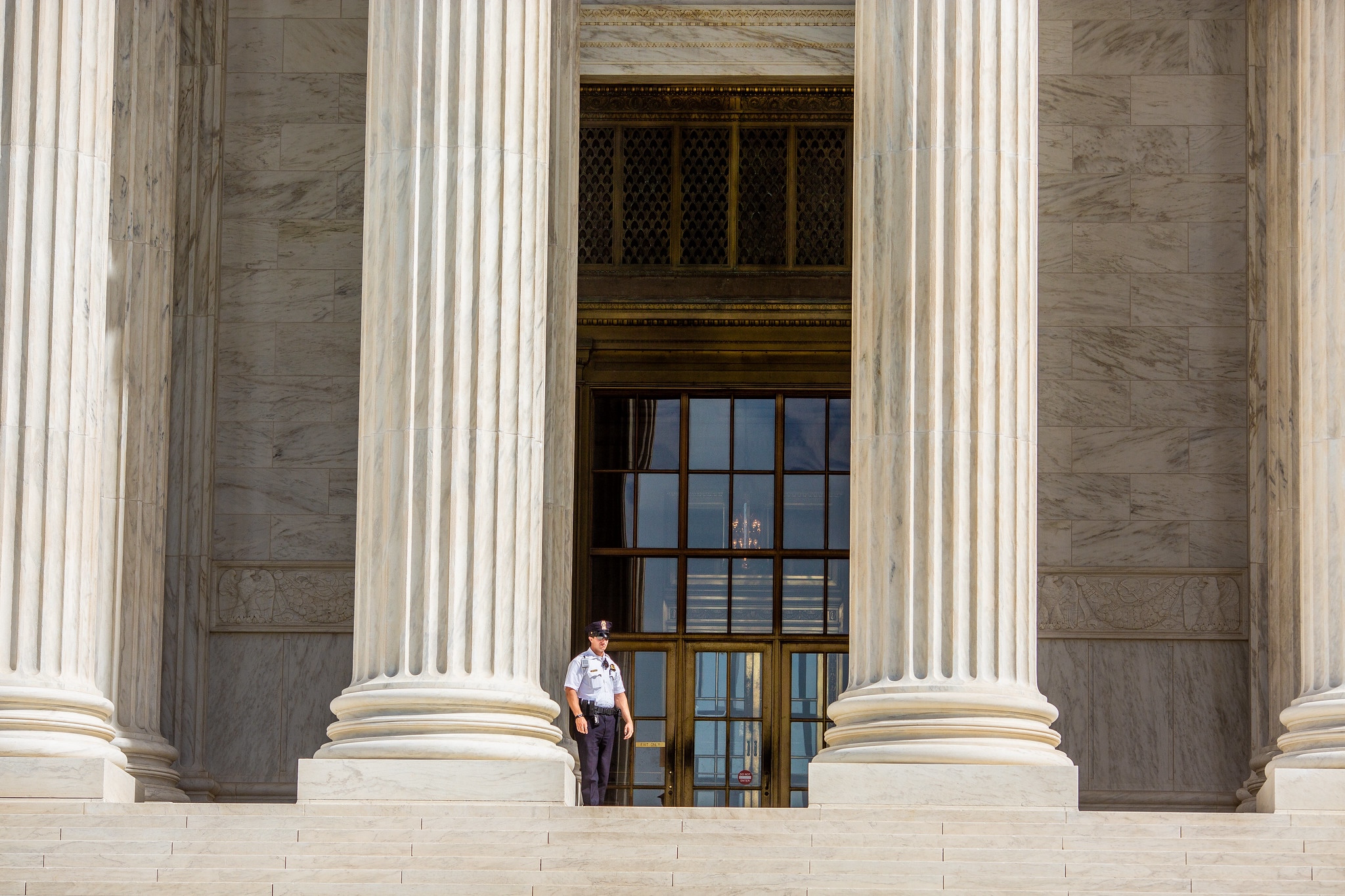
The Trump administration came to the court over a month ago. (Thomas Hawk via Flickr)
The Supreme Court will hear oral arguments on May 15 on the federal government’s request to be allowed to implement President Donald Trump’s executive order ending birthright citizenship – the guarantee of citizenship to almost everyone born in the United States, which dates back to the post-Civil War era.
The court left in place orders by three federal judges that prohibit the government from enforcing the executive order anywhere in the country until it can hear oral arguments and rule on the Trump administration’s request.
The 14th Amendment to the Constitution provides that “[a]ll persons born or naturalized in the United States, and subject to the jurisdiction thereof, are citizens of the United States and of the State wherein they reside.†It was intended to overrule one of the Supreme Court’s most infamous decisions, its 1857 ruling in Dred Scott v. Sandford, holding (by a vote of 7-2) that a Black person whose ancestors were brought to the United States and sold as enslaved persons was not entitled to any protection from the federal courts because he was not a U.S. citizen.
In 1898, the Supreme Court ruled in the case of Wong Kim Ark – who was born in San Francisco to parents of Chinese descent – that the 14th Amendment guarantees U.S. citizenship to virtually anyone born in this country. Writing for the six-justice majority, Justice Horace Gray explained that the amendment “affirms the ancient and fundamental rule of citizenship by birth within the territory, in the allegiance and under the protection of the country, including all children born here of resident aliens.â€
When campaigning for his second term in office, Trump promised to try to end birthright citizenship. Shortly after his inauguration in January of this year, he made good on that pledge, issuing his executive order indicating that people born in the United States will not be entitled to citizenship if their parents are in this country illegally or temporarily.
The order was quickly the subject of legal challenges around the country. In Seattle, Senior U.S. District Judge John Coughenour in early February blocked the Trump administration from enforcing the executive order anywhere in the United States, calling birthright citizenship “a fundamental constitutional right.â€
A federal appeals court in San Francisco turned down Trump’s request to limit Coughenour’s order to the individual plaintiffs named in the Seattle suit.
In Maryland, U.S. District Judge Deborah Boardman also temporarily barred the government from enforcing the order there, in a lawsuit brought by immigrants’ rights groups and several pregnant women. Boardman stressed that “no court in the country has ever endorsed the president’s interpretation.â€
A federal appeals court in Richmond, Va., declined to pause part of Boardman’s ruling. One judge dissented from that decision, calling the government’s request a “modest motion.â€
And in Massachusetts, U.S. District Judge Leo Sorokin granted a request from 18 states, the District of Columbia, and San Franciso to put Trump’s order on hold nationwide. He explained that allowing the Trump administration to enforce the order in some parts of the country but not others would be “inadequate,†because – for example – pregnant women living in one state could cross state lines to give birth in another state.
A federal appeals court in Boston rejected the government’s request to partially pause Sorokin’s ruling.
The Trump administration came to the Supreme Court on March 13 with what then-Acting Solicitor General Sarah Harris characterized as a “modest requestâ€: The court should put the three district judges’ orders on hold, allowing the Trump administration to enforce the order except with regard to the individual plaintiffs named in the lawsuits, the specific members of the organizations that are challenging Trump’s order who are identified in the complaint, and the individuals who live in the states challenging Trump’s order. Or at the very least, she continued, the government should be allowed to “develop[] and issu[e] public guidance regarding the implementation of†Trump’s order.
Harris complained that the kind of nationwide (sometimes also described as “universalâ€) injunctions issued in the three cases “transgress constitutional limits on courts’ powers†and “compromise the Executive Branch’s ability to carry out its functions.†She exhorted the justices to “declare that enough is enough before district courts’ burgeoning reliance on universal injunctions becomes further entrenched.â€
The challengers urged the justices to leave the three orders in place. “Being directed to follow the law as it has been universally understood for over 125 years is not an emergency warranting the extraordinary remedy of a stay,†Washington Solicitor General Noah Purcell told the court. This is particularly true, the brief filed by New Jersey and 17 other states (along with D.C. and San Francisco) added, when the Trump administration does not “even attempt†to challenge the underlying merits of the district courts’ orders.
CASA and the Asylum Seeker Advocacy Project, the two immigrants’ rights groups challenging the president’s order in Maryland (along with several expectant mothers), disputed the administration’s broader contention that district courts have issued too many nationwide injunctions that block the Trump administration from being able to “carry out its functions.†The number of nationwide injunctions issued this year, CASA emphasized, “must be understood in proportion to the number of major policies announced through Executive Orders.†Trump, CASA told the justices, “has already issued more than 100 Executive Orders in his second term, far and away the most ever for this point in a presidential term.â€Â
In a brief unsigned order on Thursday afternoon, the justices indicated that they would put off considering the Trump administration’s request to pause the three judges’ orders until the May 15 oral argument. The three cases will be argued together, beginning at 10 a.m. The justices allocated one hour for the oral argument, although it will almost certainly last much longer.
A decision in the case will likely follow by late June or early July.
This article was originally published at Howe on the Court.Â