

ARGUMENT ANALYSIS
on Apr 21, 2022
at 9:38 am
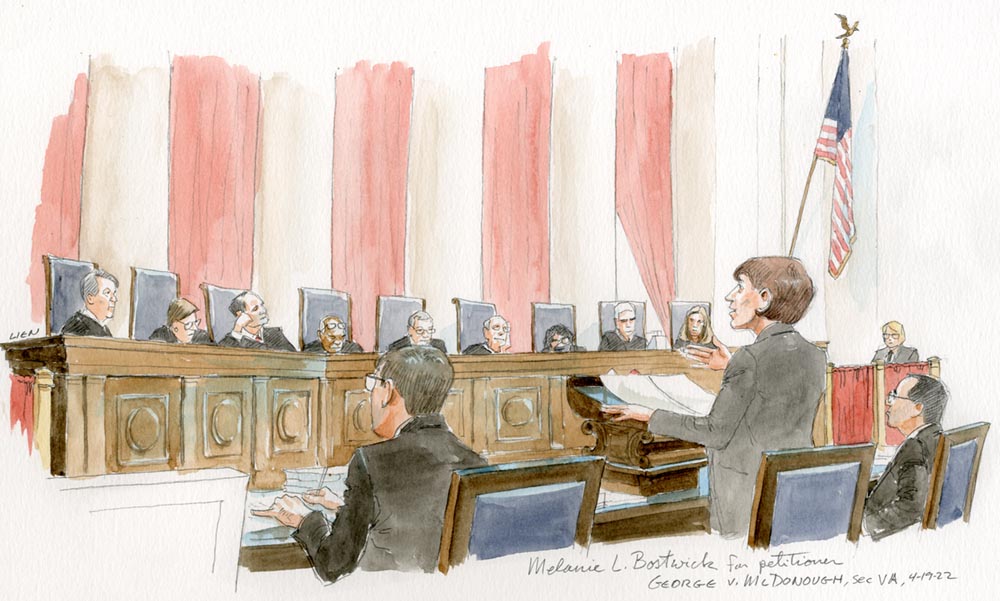
Melanie Bostwick arguing for veteran Kevin George. (Art Lien)
The justices on Tuesday delved into a dispute that may seem abstract: How should the “clear and unmistakable error†standard apply when military veterans seek to overturn certain decisions that denied them disability benefits? But during 75 minutes of oral argument in George v. McDonough, the practical consequences of the case — both for individual veterans and the agency that processes millions of benefits claims — loomed large.
The case involves a federal statute that provides compensation to veterans who are disabled as a result of injuries or diseases that are “contracted in the line of duty†or for “aggravation†of preexisting injuries or diseases. The statute also establishes that “every veteran shall be taken to have been in sound condition†at the time of enrollment unless “clear and unmistakable evidence demonstrates that the injury or disease existed before acceptance and enrollment and was not aggravated by such service†(emphasis added) A longstanding former regulation of the Department of Veterans Affairs established that a “veteran will be considered to have been in sound condition when examined, accepted and enrolled for service†unless “clear and unmistakable (obvious or manifest) evidence demonstrates that an injury or disease existed prior thereto†— leaving out the statutory phrase “and was not aggravated by such service.â€
In 2003, the VA’s general counsel concluded that the regulation was inconsistent with the text of the statute, insofar as it failed to require clear and unmistakable evidence for the government to rebut the presumption that a veteran’s injury or disease was aggravated by his military service; a year later, the U.S. Court of Appeals for the Federal Circuit reached the same conclusion, ruling that “the government must show … both a preexisting condition and a lack of in-service aggravation to overcome the presumption of soundness.â€
Kevin George is a Vietnam War veteran who suffers from paranoid schizophrenia. In 1977, the VA denied his disability claim on the ground that his mental illness pre-existed his military service. But George asserts that his military service at least aggravated his illness, and after the Federal Circuit invalidated the old “presumption of soundness†regulation, he sued to challenge the denial of his claim. The question presented is whether VA benefits denial decisions that were based on an agency regulation that has since been invalidated constitute “clear and unmistakable error†sufficient to overturn the VA’s decision and award retroactive benefits to the veteran. The answer depends on whether VA decisions that correctly applied an agency interpretation are “clearly and unmistakably†erroneous if the interpretation is later deemed incorrect.
The government argues that the phrase “clear and unmistakable error†— the statutory standard for when a benefits decision can be revised — is a term of art with an established regulatory meaning of “a very specific and rare kind of error†or “highly unusual error†that is more egregious than just clear error. As Assistant Solicitor General Anthony Yang pointed out at oral argument, “for nearly 60 years now, the regulation governing clear and unmistakable error [has] provided that such error cannot be based on a change in interpretation of the law.â€
George, conversely, contends that the term “clear and unmistakable error†must encompass clear misinterpretations of statutory text such as the omission of the statutory phrase “and was not aggravated by such service†at issue here.
The justices seemed split.Â
Justice Stephen Breyer appeared to be persuaded by George’s argument — repeatedly analogizing the error at issue to a hypothetical situation in which a statute promises a benefit to those who served in World War II or the Korean War, but the regulation “left out†the Korean War, providing the benefit only to World War II veterans. At one point, he called the invalidated regulation at issue in this case “the most clear and unmistakable error I’ve seen in 40 years.â€Â
Other justices seemed less persuaded by George’s position. Justice Samuel Alito, for example, distinguished between “adjudicative error†and “objective error†and noted that it was up to the court to decide which type of error the “clear and unmistakable†error standard encompasses. After some back and forth on this point, George’s attorney, Melanie Bostwick, invoked the “history†of “clear and unmistakable error†as well as the background interpretive presumption that Congress intends to legislate for the benefit of veterans. In a perhaps telling exchange, Alito responded skeptically with the question, “Is that a sound interpretive tool?†and asked if George had any other arguments on his side.
Justice Brett Kavanaugh appeared concerned about three traditionally non-textualist factors. First, he asked Bostwick whether there is “evidence anywhere that Congress thought any clear and unmistakable errors would trigger retroactive award of benefits back to the original time?†This focus on Congress’ intent is in direct conflict with textualism’s fundamental skepticism about the relevance — or even existence — of legislative intent generally. Second, Kavanaugh brought up a 1994 VA general counsel opinion that suggested that decisions of the Court of Veterans Appeals invalidating VA regulations or statutory interpretations do not have retroactive effect in relation to prior final adjudications of claims, and he asked Bostwick what weight should be placed on that opinion. Third, and perhaps most telling, Kavanaugh asked multiple times about the practical consequences of allowing decades-old VA denial decisions to be overturned, with retroactive benefits, because of a later judicial decision invalidating a longstanding agency regulation upon which the initial VA decision was based. He noted  that such a ruling would impose “tremendous hardship†on the agency, and asked the government to roughly estimate the implications of a ruling in George’s favor. (Yang responded that there were roughly 16 million finally adjudicated denied VA claims and 14-16 judicial decisions invalidating VA regulations. He opined that there could, accordingly, be “substantial†and even “cascading†effects for final VA adjudications if the court sides with George.) Expect this practical consideration to weigh heavily in the court’s ultimate decision.
The other justices were fairly quiet during oral argument, although Justices Elena Kagan and Amy Coney Barrett both expressed skepticism about George’s argument, while Justice Sonia Sotomayor appeared somewhat sympathetic to his position. Based on how the discussion proceeded, I would expect a decision in the government’s favor — perhaps on a 7-2, or similar, vote.