

SCOTUS NEWS
on Jan 3, 2025
at 11:45 am
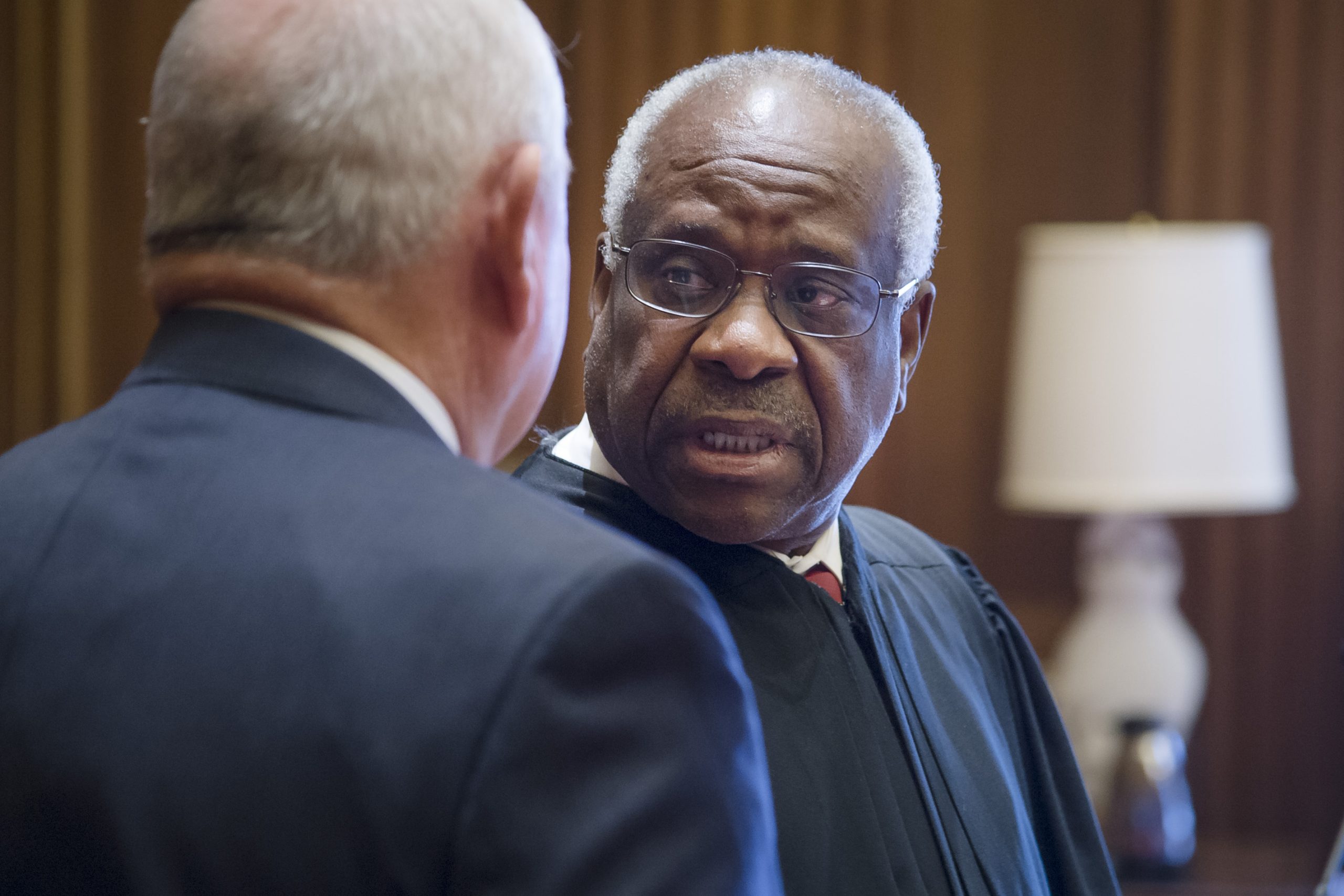
The secretary of the Judicial Conference indicated that Justice Clarence Thomas had addressed several of the lawmakers’ concerns when he filed amended financial disclosure forms. (Preston Keres via Flickr)
The federal courts will not refer complaints that Justice Clarence Thomas violated ethics laws to the Department of Justice for investigation. The national policymaking body for the federal courts on Thursday rejected Democratic lawmakers’ request to refer to the attorney general claims that Thomas violated the law when he failed to disclose luxury travel, the sale of property to billionaire Harlan Crow, and other gifts.
In identical letters to Sen. Sheldon Whitehouse, a Democrat from Rhode Island, and Rep. Hank Johnson, a Democrat from Georgia, Senior U.S. District Judge Robert Conrad, Jr., who serves as the secretary of the Judicial Conference of the United States, indicated that Thomas had filed amended financial disclosure forms that, Conrad said, “address several issues identified†in a letter sent to the conference by the two members of Congress last year. Moreover, Conrad added, it is not clear in any event whether the Judicial Conference has the power to make such referrals for Supreme Court justices.
Whitehouse and Johnson sent their request to the Judicial Conference on April 14, 2023. They cited then-recent reporting by ProPublica on Thomas’s failure to disclose the sale of property that he co-owned with his mother and the family of his late brother to Crow.
The Whitehouse and Johnson letter also pointed to a similar request, made by the Campaign Legal Center, relating to Thomas’s failure (also first reported by ProPublica) to report luxury travel on Crow’s private jet and superyachts, as well as stays at his resorts.
A subsequent letter from Whitehouse and Johnson asked for an update on the status of their request and included an appendix listing gifts and income that Thomas allegedly failed to disclose, including tuition for his grand-nephew (of whom Thomas had legal custody) to attend a private boarding school and a loan for a $267,000 recreational vehicle.
Conrad’s letter explained that the committee tasked with dealing with financial disclosures had, in March and April 2023, issued guidance indicating that the exemption from reporting for “personal hospitality†“applies only to food, lodging, or entertainment†and therefore does not apply to transportation, gifts “extended for a business purpose,†or gifts “extended at a commercial property.â€
Although the financial disclosure committee normally does not “apply new guidance retroactively to†past disclosures, Conrad continued, the committee considered whether an exception to that general rule should be made for transportation. However, in September 2024, he noted, the financial disclosure committee recommended, and the Judicial Conference agreed, that the new guidance should not apply to travel before 2022 “due to confusion arising from past guidance.â€
In his 2022 financial disclosure form, Thomas noted that both he and Judge Raymond Randolph of the U.S. Court of Appeals for the D.C. Circuit had “received guidance†from staff on the Judicial Conference that private-jet travel fell under the personal hospitality exemption.
Conrad also explained that there “is reason to doubt†whether the Judicial Conference has the power to make referrals to the attorney general for the justices, particularly when Congress has not clearly indicated that it does. He added that the Judicial Conference “plans to study this question in the months ahead.â€
The Judicial Conference also declined on Thursday to refer ethics complaints against Justice Ketanji Brown Jackson to the attorney general. In a letter to Russ Vought, the head of the conservative think tank Center for Renewing America and President-elect Donald Trump’s selection to head the Office of Management and Budget, Conrad explained that Jackson had already filed amended disclosure statements that reported outside income she and her husband received before she became a justice, as well as reimbursements for travel in 2014 and 2016.
Gabe Roth of Fix the Court, a judicial watchdog group that advocates for greater transparency at the Supreme Court, in a statement called the conference’s conclusions in the Whitehouse/Johnson letters “contrary to the plain-text reading of the financial disclosure law, which sets clear guidelines about the types of gifts that need to be reported.â€
“Even if one believes that a certain segment of Thomas’ free vacations, like his stays at Harlan Crow’s ranch or summer camp, were not reportable due to the personal hospitality exemption,†Roth said, “that still fails to explain his willful omissions of the R.V. and the private school tuition, both of which constituted five- or six-figure reportable gifts. And no amount of language-twisting in the Conference’s letters changes the fact that free transportation is not included under the subheading of gifts exempt from reporting.â€
This article was originally published at Howe on the Court.Â