

OPINION ANALYSIS
on Feb 25, 2025
at 3:01 pm
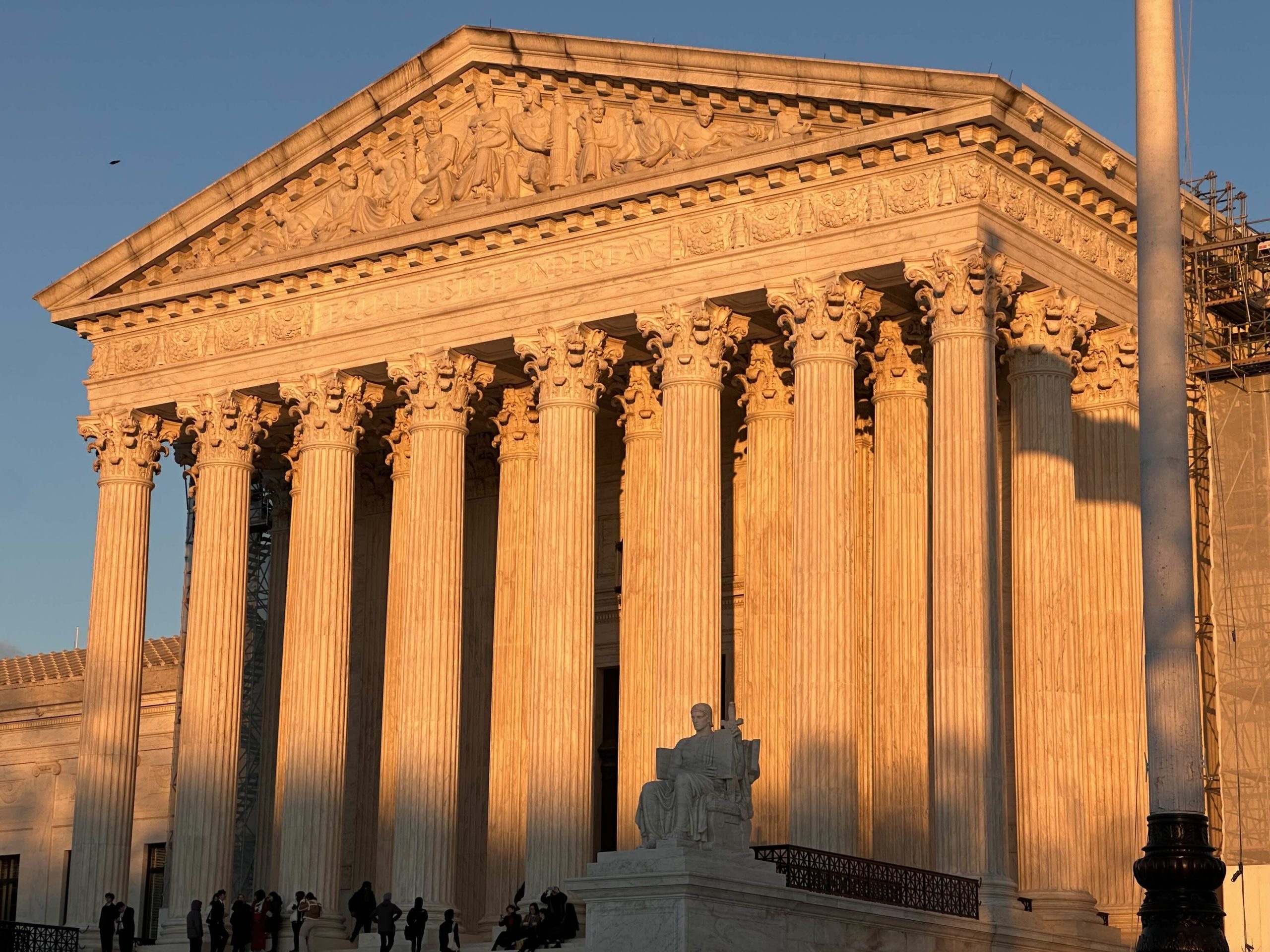
The court issued rulings in Glossip v. Oklahoma and Lackey v. Stinnie on Tuesday morning. (Katie Barlow)
The Supreme Court on Tuesday ruled that a group of Virginia drivers challenging a state motor vehicle law was not entitled to reimbursement of their attorney’s fees even though a federal district court issued an order in their favor that temporarily prohibited the state from enforcing the law and the state’s legislature repealed the law. By a vote of 7-2, the court held that the drivers are not “prevailing parties†for purposes of a federal law that allows the winners in some civil rights cases to recover reasonable attorney’s fees.
Chief Justice John Roberts wrote for the majority. Justice Ketanji Brown Jackson dissented, in an opinion joined by Justice Sonia Sotomayor.
The case began in 2018 as a challenge to the constitutionality of a Virginia law that requires the automatic suspension of the driver’s licenses of anyone with unpaid court fines and fees. When a federal district court in Virginia granted the drivers’ request for a preliminary injunction that would bar the state from enforcing the law while the litigation continued, the state did not appeal.
In April 2020, the Virginia legislature repealed the law and required the DMV to permanently reinstate the licenses of drivers suspended under the law. That prompted the district court to dismiss the case as moot – that is, no longer a live controversy.
In most litigation in the United States, each side pays for its own attorney’s fees. But in 1976, Congress enacted the Civil Rights Attorney’s Fees Awards Act, which gives courts in some civil rights cases the discretion to award a “reasonable attorney’s fee†to “the prevailing party.â€
The drivers sought to recover their attorney’s fees, arguing that they were “prevailing parties†because the district court had ordered the DMV to reinstate their licenses. The U.S. Court of Appeals for the 4th Circuit agreed with them.
On Tuesday, the Supreme Court reversed the 4th Circuit’s decision.
Roberts explained that when Congress enacted the fee-shifting provision, whether a plaintiff was a “prevailing party†did not “depend upon the degree of success at different stages of the†lawsuit, but instead on “whether, at the end of the suit,†the plaintiff has succeeded.
But winning a preliminary injunction, like the one that the district court issued in this case, Roberts reasoned, cannot make a plaintiff a prevailing party, because in such a scenario the plaintiff “has achieved only temporary success at an intermediary stage of the†lawsuit.
Indeed, Roberts noted, it is not uncommon for courts to issue a preliminary injunction, only to reach a different result after it considers the merits of the case more fully. And the fact that events outside the case leave the dispute moot, Roberts emphasized, cannot “convert a temporary order†like a preliminary injunction, which is “designed to preserve the status of the parties,†into “a conclusive adjudication of their rights†that can make a plaintiff a “prevailing party†for purposes of a fee award.
Holding that the drivers in this case are not “prevailing parties†is also consistent with the court’s earlier cases involving attorney’s fee awards in civil rights cases. In 2001, Roberts noted, the court rejected the idea that a plaintiff can receive attorney’s fees when a defendant voluntarily changes its behavior in response to the lawsuit. That case, he explained, made clear that the change in the legal relationship between the plaintiff and the defendant must be “judicially sanctioned.â€
And six years later, the court held that a plaintiff who obtained a preliminary injunction but not a permanent one was not a “prevailing party†because the change in the legal relationships was not “enduring.â€
“Today,†Roberts wrote, “we establish that the enduring nature of that change must itself be judicially sanctioned. A plaintiff who wins a transient victory on a preliminary injunction does not become a ‘prevailing party’ simply because external events convert the transient victory into a lasting one. Rather,†he concluded, “a plaintiff ‘prevails’ under the statute when a court conclusively resolves a claim that materially alters the legal relationship between the parties.â€
By creating a “straightforward, bright-line rule,†Roberts added, Tuesday’s decision also reduces the likelihood that civil rights litigation will be followed by “a second major litigation†seeking attorney’s fees. Roberts pushed back against the drivers’ suggestion that the rule will lead the government, after a preliminary injunction is entered against it, to take steps to moot the case so that it can avoid the risk of having to pay attorney’s fees. Roberts dismissed the drivers’ concerns as mere speculation, and unlikely to arise often.
In her dissent, Jackson questioned the majority’s assertion that Tuesday’s ruling “follows naturally from†the court’s earlier decisions. She stressed that of the 11 federal courts of appeals that have considered the question, “all of them agree that at least some preliminary injunctions trigger fee eligibility†under the federal law.
In Jackson’s view, the majority’s conclusion that a plaintiff who obtains a preliminary injunction can never recover attorney’s fees “lacks any basis†in the text of the law. Moreover, she warned, it is “plainly inconsistent with that statutory provision’s clear objective, which is to encourage attorneys to file civil rights actions on behalf of the most vulnerable people in our society.â€
This article was originally published at Howe on the Court.Â