


CASE PREVIEW
on Dec 6, 2021
at 8:59 pm
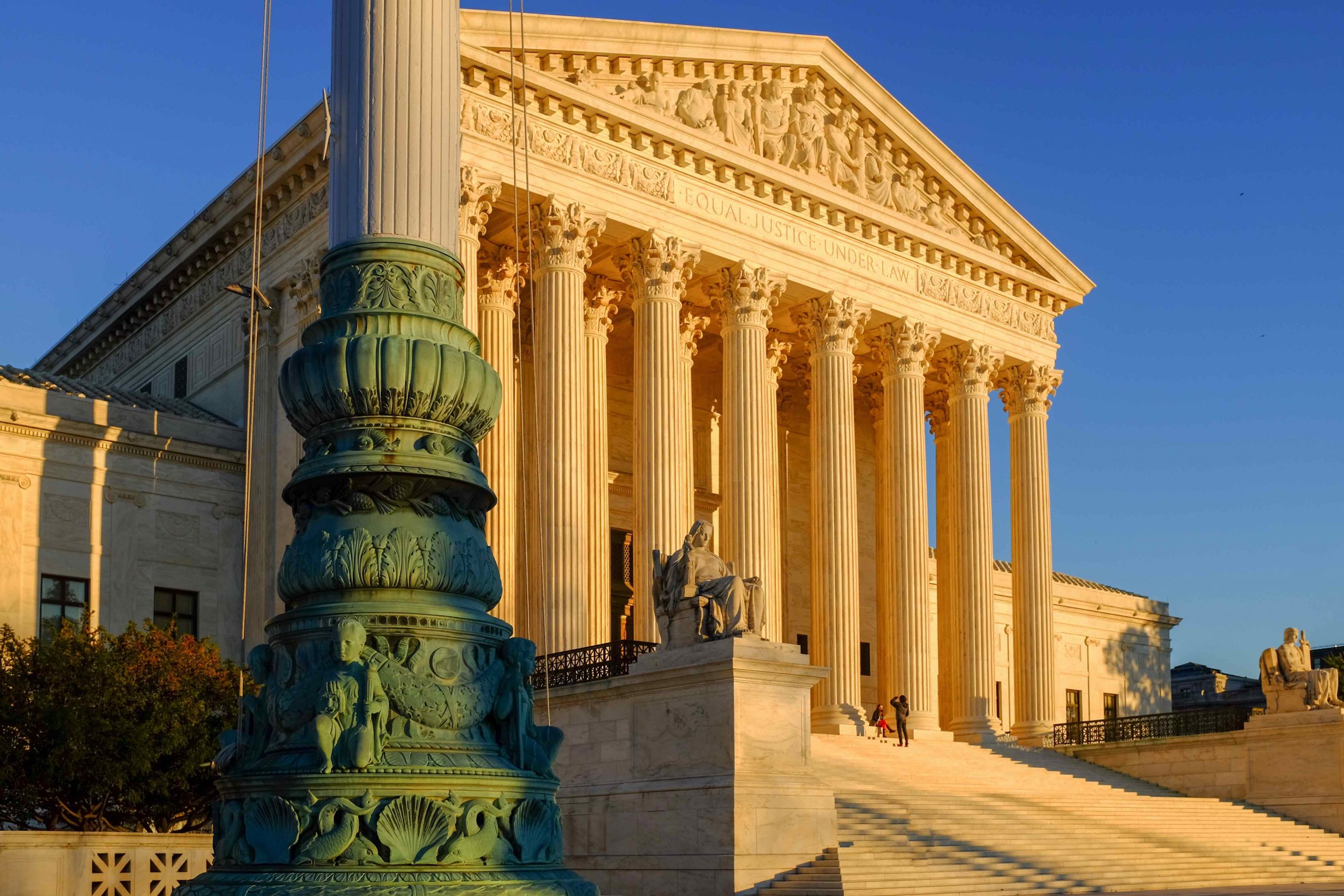
On Tuesday, the Supreme Court will hear a case on the scope of a federal law that punishes using a gun during a violent crime. (Orham Cam via Shutterstock)
If a person attempts to commit a robbery but does not succeed, is the attempt alone a “crime of violence� On Tuesday, the Supreme Court will delve into that question in United States v. Taylor, the latest in a string of cases asking the justices to narrow federal definitions of violent crimes.
In 2003, Justin Eugene Taylor sold marijuana in Richmond, Virginia. He and an accomplice planned to steal money from Martin Silvester, a prospective buyer. After meeting Silvester in an alley, the accomplice pulled out a semiautomatic pistol and tried to take Silvester’s cash while Taylor waited nearby in a getaway car. Silvester resisted, and the accomplice fatally shot him. Taylor and the accomplice fled the scene, having failed to collect Silvester’s money.
Six years later, the federal government prosecuted Taylor. He was convicted under a plea agreement and sentenced to 30 years in prison. Taylor now challenges part of that conviction and seeks a reduced sentence.
The case involves the interaction of two federal criminal statutes. The first is the Hobbs Act, a 1946 law that makes it a federal crime to commit robbery (or attempt to do so) in a way that affects interstate commerce. The Hobbs Act defines robbery as unlawfully taking another person’s property “by means of actual or threatened force.â€
The second statute is 18 U.S.C. § 924(c), which makes it a federal crime to use a gun in connection with any “crime of violence†that can be prosecuted in federal court. Section 924(c) purports to define “crime of violence†in two ways. Under the so-called “elements clause,†a crime of violence is any felony that “has as an element the use, attempted use, or threatened use of physical force against the person or property of another.†Under the so-called “residual clause,†a crime of violence can also include any felony that, “by its nature,†entails “a substantial risk†of physical force. In 2019, the Supreme Court found the residual clause to be unconstitutionally vague. As a result, only the first definition of “crime of violence†— the elements clause — remains in effect.
Taylor is contesting his conviction under Section 924(c), which accounts for one-third of his 30-year sentence. The government defends the conviction by arguing that Taylor used a gun in connection with an attempted robbery under the Hobbs Act. The parties do not dispute that Taylor used a gun. Nor do they dispute that Taylor committed attempted robbery under the Hobbs Act. They very much dispute, however, whether attempted robbery under the Hobbs Act meets Section 924(c)’s definition of “crime of violence.†The district court sided with the government, but the U.S. Court of Appeals for the 4th Circuit (in a decision that created a split with three other circuits) sided with Taylor.
At the Supreme Court, both sides agree that a completed Hobbs Act robbery counts as a crime of violence under Section 924(c). After all, to commit robbery under the Hobbs Act, a person must either use “actual†physical force or threaten the use of force.
But Taylor did not commit a robbery under the Hobbs Act. He and his accomplice fled the scene before taking Silvester’s money, so they never completed the robbery itself. Rather, the only possible basis for a violation of Section 924(c) is Taylor’s commission of an attempted robbery under the Hobbs Act.
Whether that attempt counts as a crime of violence does not hinge on Taylor’s specific conduct. Instead, the Supreme Court uses a method known as the “categorical approach,†which involves looking only at the baseline statutory elements of a predicate crime to determine whether it’s a crime of violence. In line with that method, both sides spend most of their briefs meticulously parsing the language of the two interlocking statutes. But underlying the case is a broader, metaphysical question about what it means to “attempt†something at all.
Taylor argues that attempted Hobbs Act robbery contains two elements: an intent to commit a robbery that would (if completed) qualify under the Hobbs Act, and at least one “substantial step†toward committing that robbery. The substantial step, he notes, need not involve violence or the threat of violence. For instance, merely casing a store without violence might satisfy the “substantial step†element.
In addition, Hobbs Act robbery does not necessarily entail the use of violence; it also can be committed solely through the threat of force. By extension, Taylor argues, attempted Hobbs Act robbery can be committed merely through “an attempt to threaten force†— even if that threat is never expressed.
The upshot for Taylor is that violence is nowhere to be found in the required elements of attempted Hobbs Act robbery. Unlike with completed Hobbs Act robberies, he asserts, the government could obtain a conviction for attempted Hobbs Act robbery without proving that the defendant used force, attempted to use force, or actually threatened the use of force. And because violence is not a required element, attempted Hobbs Act robbery does not meet the definition of “crime of violence†under Section 924(c).
The government contends that the three-pronged structure of Section 924(c)’s elements-clause definition shows that the definition should be read broadly. Congress, the government says, meant for the definition to encompass “all crimes involving substantial efforts to instrumentalize force or obtain others’ property, even if those efforts fail.†Any conduct that is “substantial enough†to qualify as attempted Hobbs Act robbery conveys an intent to inflict harm and inherently “threatens the use of force,†the government argues.
The government also points out that attempted robberies are frequently more violent than completed robberies, because violent confrontations often prevent would-be robbers from completing their crimes. Omitting attempted robberies from the definition of “crime of violence†would leave “a gaping hole†in Section 924(c), the government says. It also would jeopardize hundreds of Section 924(c) prosecutions based on attempted robbery every year, the government suggests.
The court has heard similar warnings from the government before in cases involving capacious statutory definitions of violent crimes. But that hasn’t stopped the justices from narrowing those definitions — including in 2019 in United States v. Davis (which found Section 924(c)’s “residual clause†unconstitutional) and earlier this year in Borden v. United States (which trimmed the definition of “violent felony†in the Armed Career Criminal Act). At Tuesday’s argument, the justices are bound to explore how closely those cases resemble this one.
Attempting to sway them will be a familiar face — albeit on the opposite side than the justices and court-watchers are accustomed to. Representing Taylor will be Michael Dreeben, who spent three decades in the solicitor general’s office before joining a D.C. law firm in 2019. In the solicitor general’s office, Dreeben argued 105 Supreme Court cases and developed a specialty in criminal law. Last month, in a First Amendment challenge to a city’s sign regulations, he argued his first Supreme Court case as a lawyer in private practice. And on Tuesday, when he takes the lectern on behalf of Taylor, he will argue his second such case (and his 107th overall). He’ll face Assistant to the Solicitor General Rebecca Taibleson, who is appearing before the justices for the second time.