

CASE PREVIEW
on Jan 17, 2022
at 6:51 pm
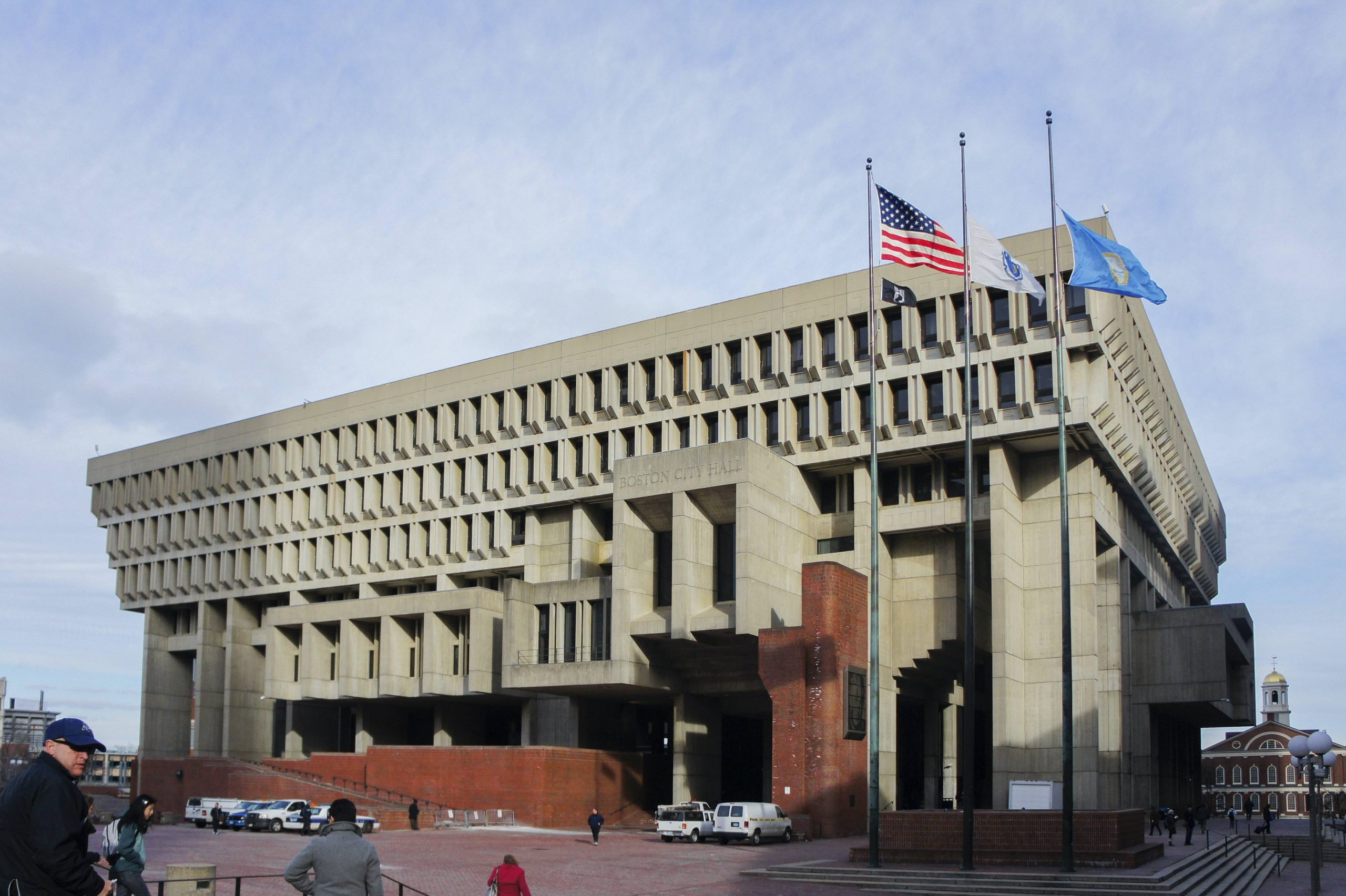
Three flagpoles stand in front of Boston’s city hall. The city rejected an outside group’s request to fly a Christian flag on one of them. (Kit Leong via Shutterstock)
When it hears oral argument on Tuesday in Shurtleff v. City of Boston, the Supreme Court will return to the role of religion in public spaces. The question comes to the court in an important free speech case arising from Boston’s practice of allowing outside groups to fly their flags on one of the three flagpoles in front of city hall. A group that was denied permission to fly a “Christian flag†there contends that the city’s policy unconstitutionally silences unpopular speech, while the city counters that it needs the ability to decide what messages it conveys through the flags that fly on its flagpoles.
The city normally flies the same three flags on the flagpoles: the American flag and the POW/MIA flag on one flagpole, the Massachusetts flag on the second flagpole, and its own flag on the third. Occasionally, however, the city will grant a request to swap out another flag for its own. Over the past 12 years, it has flown the flag of other countries (including China and Cuba), as well as flags for groups such as Boston Pride (an LGBTQ group) and the National Juneteenth Observance Foundation.
The case before the court on Tuesday arose in 2017, when Harold Shurtleff applied to fly a “Christian flag,†bearing a cross, on the third flagpole in connection with an event that he wanted to hold on the plaza in front of city hall. The flag represents Camp Constitution, the group that he founded that seeks “to enhance understanding of the country’s Judeo-Christian moral heritage.†The city denied Shurtleff’s initial request, and it didn’t respond to a second request.
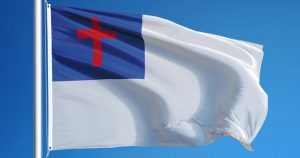
The Camp Constitution flag.
Shurtleff sued the city in federal court, arguing that the city’s rejection of his request violated Camp Constitution’s right to free speech and the Constitution’s establishment clause, which bars the city both from favoring one religion at the expense of another and from preferring religion over nonreligion. A federal district court ruled for the city, and the U.S. Court of Appeals upheld that ruling. It reasoned that flying other groups’ flags on the city’s flagpole amounted to speech by the city, which allows it to choose which flags it wants to fly without being subject to discrimination claims. The court of appeals ruled that the city’s rejection of Shurtleff’s request also did not violate the establishment clause. Shurtleff came to the Supreme Court in June 2021, asking the justices to weigh in, which they agreed to do.
In his brief on the merits, Shurtleff contends that because the city has opened up the flagpoles for private flag raisings, the flagpoles are not speech by the city but instead a “public forum,†where the government can’t impose restrictions based on the speaker’s viewpoint. Restrictions based on the content of the speech in a public forum, Shurtleff adds, must pass the most stringent constitutional test, known as strict scrutiny.
When the city rejected Shurtleff’s request to raise Camp Constitution’s flag only because it was called a “Christian†flag, he argues, it discriminated against Shurtleff and Camp Constitution based on their viewpoint and based on the content of their speech. The city cannot excuse its exclusion of the flag on the ground that it was trying to avoid violating the establishment clause, he observes. The establishment clause, he stresses, only prohibits government speech endorsing religion, not private speech. And the private flags on the city’s flagpoles cannot be (contrary to the 1st Circuit’s ruling) government speech, he suggests: The city did not review any of the 284 other private flags that were raised on the third flagpole, much less exercise the kind of direct and effective control over the flags and the messages that they convey that would make them government speech.
The city’s program is also not saved by its requirement that private groups wanting to fly their own flags apply for permission and receive approval, thereby – in the city’s view – converting the flags into government speech. “Accepting the City’s rationale,†Shurtleff cautions the justices, “would vastly expand and sanction dangerous aspects of the government-speech doctrine,†allowing the government to stifle unpopular speech.
The Biden administration filed a “friend of the court†brief in which it agrees with Shurtleff that Boston’s “flag-raising program is not government speech, but instead a forum for private speech.†However, it urges the justices to “reaffirm that the First Amendment affords the City and other governments ample latitude to craft expressive programs — including programs involving contributions from private parties — without relinquishing their right to control the message or exclude other private speakers.â€
The city disputes the idea that its flagpoles are a public forum. Instead, it contends, the flagpoles are a place for it to convey its own messages, and the public would certainly see them as such. The city only occasionally allows other groups to fly their flags on the third flagpole as part of its community-building efforts, and the city maintains that the program is not the kind of “free for all†open to anyone that Shurtleff depicts.
Because the flags flying on the city’s poles are the city’s speech, the city concludes, it could decline Shurtleff’s request to fly the Camp Constitution flag. Since then, it tells the justices, it has ended the flag-raising program so that it does not have to convey messages that are contrary to its own principles. It is, the city emphasizes, “critically important that governments retain the right and ability to speak on behalf of their constituents and take positions and privilege certain viewpoints when doing so.â€
This article was originally published at Howe on the Court.