

[ad_1]
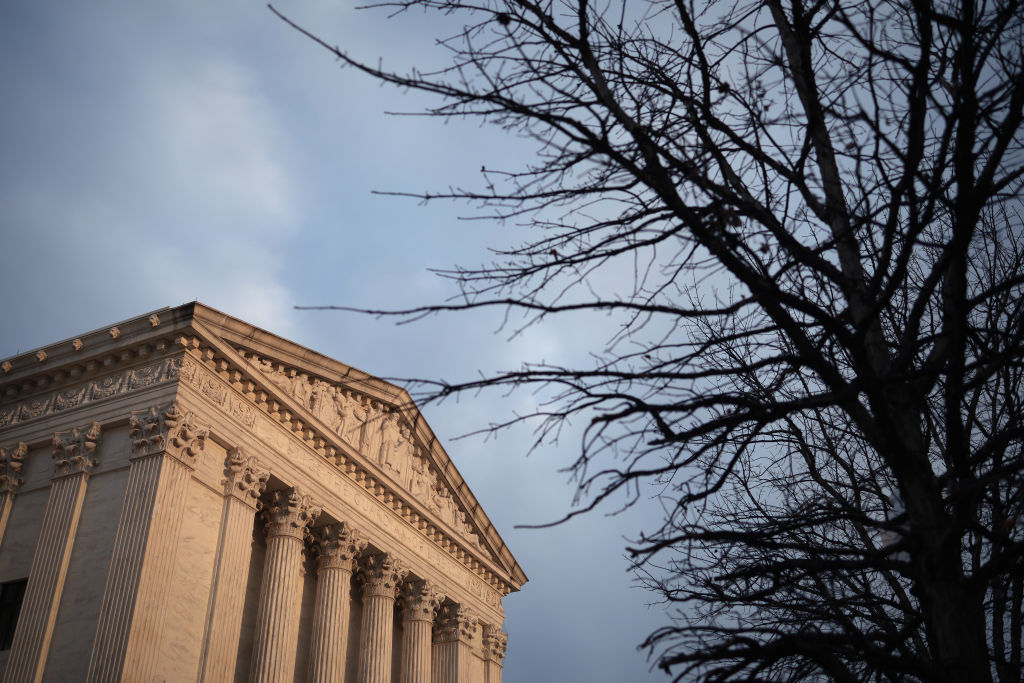
The Supreme Court will hear arguments on Tuesday, Dec. 2, in a case brought by First Choice Women’s Resource Centers, a group of faith-based pregnancy centers that the New Jersey attorney general’s office alleges may have misled women about whether it provides certain reproductive-health services. The question before the court is a somewhat technical one: Whether a federal court has the authority to rule on First Choice’s claim that New Jersey’s demand for information about the group’s fundraising practices discouraged it from exercising its First Amendment rights, or whether the group must instead litigate that claim in state proceedings.Â
First Choice describes itself as “a faith-based nonprofit†that provides “material support and medical services like ultrasounds and pregnancy tests under the direction of a licensed medical director.†In 2023, New Jersey’s attorney general, Matthew Platkin, issued subpoenas to First Choice in which he sought (among other things) information about the group’s donors. The subpoenas asked First Choice to turn over documents sent to donors, as well as the identities of all donors, except for those who made their donations through a specific website. Â
First Choice went to federal court, where it filed a civil rights claim challenging the subpoena. It contended that the subpoena had or will have a chilling effect on its First Amendment rights and those of its donors – that is, among other things, that it will deter donors from making additional contributions and, through its request for the identities of First Choice’s staff, caused the group to remove videos that identified its staff from its YouTube channel.Â
U.S. District Judge Michael Shipp concluded that the dispute was not yet ready for a federal court to review – a doctrine known as “ripeness†– because only a state court has the power to enforce or quash a subpoena, and the state court had not yet done so.
The attorney general then went to state court in New Jersey, seeking to enforce the subpoena. That court rejected First Choice’s request to quash the subpoena, and it granted the state’s request to enforce the subpoena, instructing First Choice to “respond fully†to the state’s requests – an instruction, the state court later clarified, that allowed First Choice to object to those requests.Â
First Choice’s efforts to seek relief in federal court returned to the district court, which once again ruled that the dispute was not yet ripe. This time, Shipp explained, although the state court had granted the attorney general’s request to enforce the subpoena, it had not yet determined whether First Choice would be required to face sanctions if it did not hand over the documents.Â
A divided panel of the U.S. Court of Appeals for the 3rd Circuit upheld Shipp’s ruling. In a brief, unsigned opinion, the majority explained that First Choice “can continue to assert its constitutional claims in state court as that litigation unfolds; the parties have been ordered by the state court to negotiate to narrow the subpoena’s scope; they have agreed to so negotiate; the Attorney General has conceded that he seeks donor information from only two websites; and First Choice’s current affidavits do not yet show enough of an injury.â€Â
In a footnote, the opinion indicated that Judge Stephanos Bibas dissented “because he believes that this case is indistinguishable from Americans for Prosperity Foundation v. Bonta,†the Supreme Court’s 2021 decision striking down, on First Amendment grounds, California’s requirement that charities and nonprofits in the state provide the state attorney general’s office with the names and addresses of their largest donors.Â
First Choice then came to the Supreme Court, which in June agreed to weigh in.Â
In its brief on the merits, First Choice stressed that, “[f]or nearly three quarters of a century, this Court has recognized the right to maintain the confidentiality of one’s associations from government disclosure demands.†The court in 1958, it noted, held that Alabama could not compel the NAACP to disclose its membership lists. “It is hardly a novel perception … that compelled disclosure of affiliation with groups engaged in advocacy may constitute as effective a restraint on freedom of association as [other] forms of governmental action,†First Choice wrote (quoting that decision). But “[u]nder the Third Circuit’s logic,†First Choice contended, “the NAACP could not have availed itself of federal court if it received a subpoena from a hostile state†– even though Section 1983, the federal civil rights provision on which First Choice relied to bring its case in federal court, was “enacted to guarantee ‘a federal forum for claims of unconstitutional treatment at the hands of state officials.’â€Â
This means, First Choice asserted, that plaintiffs are not required to go to state court before bringing a constitutional claim under Section 1983. Instead, First Choice argued, its claims are ripe for review now, without waiting for the state court to weigh in. Even without an order from the state court, Platkin’s “demand for donor disclosure objectively chills First Choice’s associational and speech rights, causing its donors to think twice before supporting the faith-based nonprofit,†First Choice argued. Indeed, First Choice noted, declarations from donors whose identities would be disclosed if First Choice complied with the subpoena indicated that they would have been less likely to donate to the nonprofit if they had “’known information about the donation might be disclosed to an official hostile to pro-life organizations.’â€Â
First Choice also discussed for purposes of whether its claim is ripe the significance of the fact that Platkin’s subpoena is “non-self-executing,†in that the attorney general does not himself have the power to enforce it but instead must go to court and obtain an order requiring First Choice to produce the documents that the subpoena seeks. First, the group said, “virtually all subpoenas are ‘non-self-executing’†because only courts can impose penalties for failure to comply with the subpoenas. But in any event, First Choice continued, the text of the subpoena indicates that it is in fact self-executing: “The document cautions that ‘[f]ailure to comply with this Subpoena may render you liable for contempt of Court and such other penalties as are provided by law. It does not say, ‘failure to comply with a later court order may render you liable.’â€Â
First Choice further warned of a potentially sweeping impact if the Supreme Court were to uphold the 3rd Circuit’s rule. According to the organization, “[t]he targets of state subpoenas extend far beyond pregnancy centers. They run the gamut of ideological and business interests, including large tech companies, professional sports leagues, energy companies, firearms groups, and immigrant and LGBTQ advocacy groups. When subpoenas violate the federal constitution, these groups should not be relegated to state court to enforce their rights.â€Â
First Choice asserted that it had a right to be in court for a separate reason beyond the deterrent effect that the subpoena’s donor disclosure demand would have. The group is also injured, it contended, by the “credible threat of enforcement of the subpoena.†Indeed, First Choice stressed, the attorney general “is currently seeking to enforce his subpoena in state court,†and the court does “not require a plaintiff to expose himself to liability before bringing suit to challenge the basis for the threat.â€Â Â
The federal government filed a “friend of the court†brief supporting First Choice. U.S. Solicitor General D. John Sauer told the justices that this was “a simple case.†Once the state issued a subpoena to First Choice “that demanded compliance and threatened sanctions,†the “credible threat†that a court would enforce the subpoena meant that the group’s claims were ripe for review; “the burdens of defending against litigation and the risk of being forced to turn over the subpoenaed documents qualify as concrete injuries[;] and the threatened injuries were sufficiently imminent†for the lawsuit to move forward.Â
In its brief on the merits, the state characterized the question before the court as a “narrow†one that is quite different from that presented by First Choice. Both sides, the state said, agree that if First Choice’s injury is ripe, then it can litigate its claim under Section 1983. “Instead,†the state contended, “the real dispute in this case†is whether First Choice “sufficiently alleged a reasonably objective chill of its First Amendment rights from this Subpoena.â€Â
The subpoena that the attorney general issued, the state emphasized, is not self-executing; as a result, any injuries that First Choice might suffer are only speculative and thus not ripe for federal review. This is because First Choice will only face penalties, the state wrote, if a state court “issues an order requiring the production of documents—and even then, only if†it holds First Choice “in contempt for failing to comply with that judicial order.†But, “[h]ere, although the State issued the Subpoena in 2023, the state trial court has repeatedly declined to issue an order requiring document production and has ordered the parties to negotiate instead.â€Â
Moreover, the state said, the attorney general’s subpoena would not deter donors, because it “explicitly carves out ways for donors to contribute without any risk of disclosure†through one specific website. And there is no reason to believe that the state would disclose the identities of First Choice donors to the public, the state wrote. “To the contrary, State law requires state officials to protect this information from disclosure.â€Â
Because First Choice cannot show that the subpoena chills its First Amendment rights, the state argued, it instead relies on “a more radical theoryâ€: the idea that the “mere receipt of a non-self-executing subpoena that a State is likely to seek to enforce always creates†a claim that a federal court can review. But to have a legal right to sue, the state said, a plaintiff must have an “imminent injury†– which “cannot be satisfied by ‘allegations of possible future injury.’â€Â
A decision in the case is expected by late June or early July.Â
Cases: First Choice Women’s Resource Centers, Inc. v. Platkin
Recommended Citation:
Amy Howe,
Court to hear arguments on faith-based pregnancy centers’ challenge to state subpoena,
SCOTUSblog (Nov. 26, 2025, 9:30 AM),
https://www.scotusblog.com/2025/11/court-to-hear-arguments-on-faith-based-pregnancy-centers-challenge-to-state-subpoena/
[ad_2]
Source link