
The courtroom is quite full today as we near the end of the term. A key reason for that is this is the last day for in-person admissions to the Supreme Court Bar. The bar section is packed with groups to be moved for admission from City University of New York School of Law, Georgetown University Law Center, and the National Organization of Social Security Claimants’ Representatives, who would seem to have a lot on their plates these days.
We in the press section don’t see any spouses of the justices here, but the guest box has a handful of folks filling the seats. In the public section, I recognize Gabe Roth of Fix the Court, who was quite busy yesterday dissecting the justices’ annual disclosure forms. Roth tells me later that he obtained a lottery ticket for today’s session under the inaugural reservation system implemented in February. He says he applied for tickets in each argument sitting and for the standalone, scheduled opinion days. He was awarded a ticket three times, twice for arguments and today for opinions. As best he could tell, at least a few people from the “non-ticketed/old school line†got in each of the days he was in the courtroom.
A few minutes before 10 a.m., U.S. Solicitor General D. John Sauer arrives with several of his deputies and assistants. That is customary, but this is the first time Sauer himself has led the office contingent on an opinion-only day. Evidently he has been busy writing emergency docket applications those other mornings. (Deputy solicitors general such as Malcolm Stewart and Curtis Gannon have led the delegation on recent opinion days.) The SG staff members occupy the seats at the counsel tables on each side of the lectern and prepare to spend their time listening rather than making arguments.
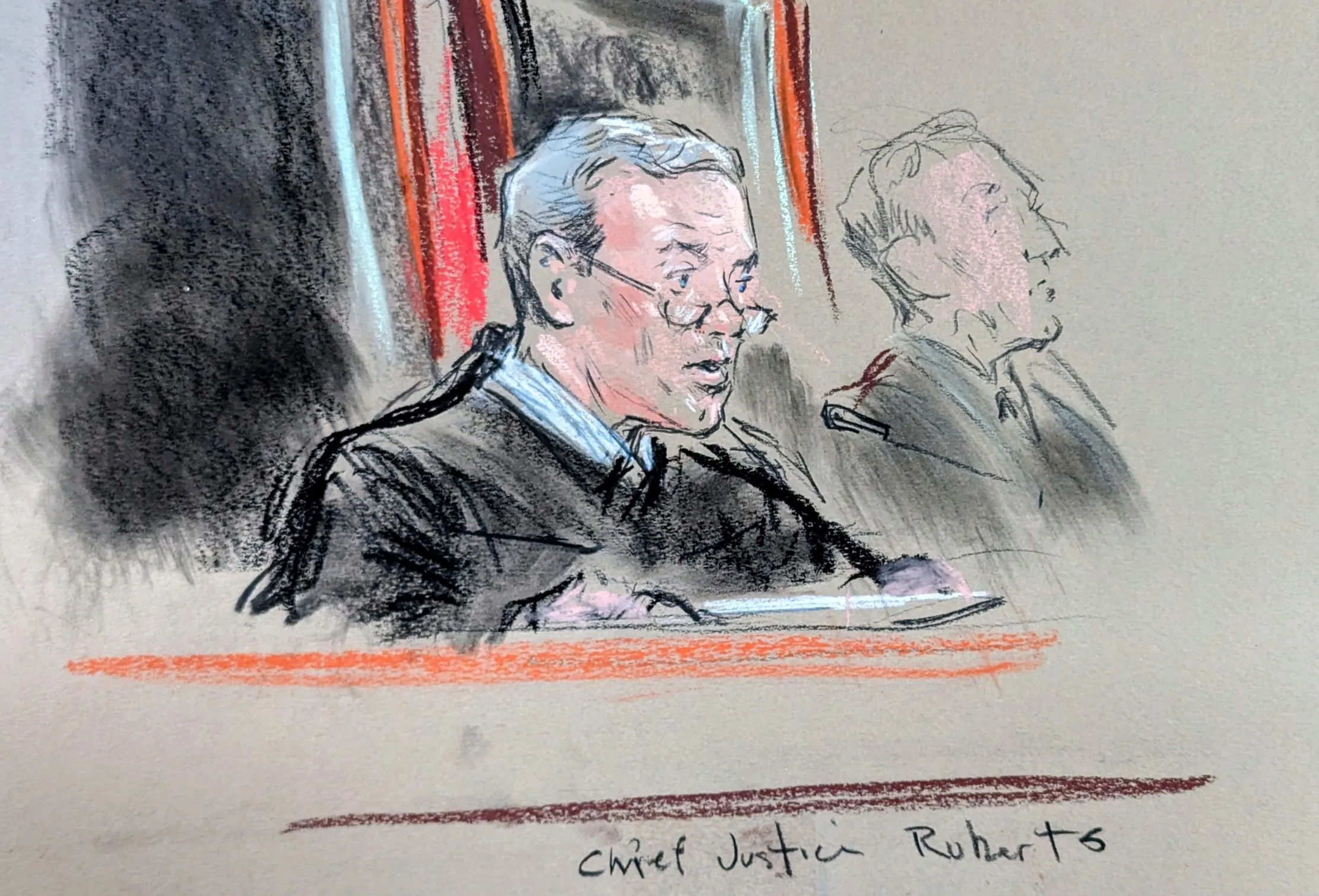
When the justices take the bench, all are present. (There haven’t been many absences this opinion season.) Chief Justice John Roberts announces that Justice Brett Kavanaugh has the opinion in Nuclear Regulatory Commission v. Texas.
Kavanaugh starts in 1954 with the passage of the Atomic Energy Act, which allowed for private commercial nuclear power plants. Today, more than 50 such plants produce electricity for American homes, generating almost 20 percent of electricity in the nation, he says. Of course, there is the matter of nuclear waste. Most spent nuclear fuel is stored on site at nuclear plants, especially given that the effort to create a permanent repository has stalled.
As Kavanaugh continues, my mind starts to wander to “The Simpsons,†with its Springfield Nuclear Power Plant and several episodes depicting creative ways the plant has disposed of its nuclear waste. This won’t be the only time I think about “The Simpsons†this morning, but I’ll come back to that.
The court decides that Texas and a private litigant were not parties to the NRC’s licensing proceeding and thus could not obtain judicial review of the commission’s approval for a proposed off-site storage facility. The court does not decide whether the NRC has statutory authority to issue the storage license. It is at least a partial victory for the federal government, and for Stewart, who argued the case in March and is here today.
Roberts says that Justice Clarence “has the opinion of the court in the next two cases.â€
Thomas delivers summaries of Environmental Protection Agency v. Calumet Shreveport Refining, a modest and technical victory for the government; and Oklahoma v. EPA, an arguably modest and technical defeat for the government. Both cases involved the Clean Air Act, and both were also argued for the government by Stewart, so he chalks up another victory but also a loss.
So, it looks like a nice environmental law theme day and we’re done, right? Not so fast.
Roberts announces that he has the opinion in United States v. Skrmetti, about Tennessee’s law barring puberty blockers and hormone treatments for transgender minors. It was argued in December and is one of the most anticipated decisions of the term.
The chief justice soon confirms what the oral argument suggested, that the law known as SB1 is not subject to heightened scrutiny under the 14th Amendment’s equal protection clause but mere rational-basis review, which it satisfies.
The Tennessee law classifies based on age and medical use, but not sex, Roberts says. He explains his opinion at some length, including about how health authorities in Finland, England, and Sweden have raised concerns about the potential harms of using puberty blockers and hormone treatments on transgender minors.
“We do not rely†on these foreign sources, he says, but they provide valuable context.
He concludes with a version of his closing paragraphs, that “this case carries with it the weight of fierce scientific and policy debates about the safety, efficacy, and propriety of medical treatments in an evolving field†and that “the Equal Protection Clause does not resolve these disagreements. Nor does it afford us license to decide them as we see best. Our role is not to judge the wisdom, fairness, or logic of the law before us.â€
“We leave questions regarding its policy to the people, their elected representatives, and the democratic process,†Roberts says.
After the chief announces the lineup, there is a pause as it becomes clear one of the three members of the dissent, either Justice Sonia Sotomayor, Justice Elena Kagan, or Justice Ketanji Brown Jackson, will deliver the term’s first dissent from the bench.
It is Sotomayor, who says “the court abandons transgender children and their families to political whims.â€
She will go on for more than 15 minutes, citing details about the plaintiff identified in court papers as Ryan Roe, who is now 16 and once contemplated “going mute†as a response to his gender dysphoria.
As she discusses her view that the majority is trying to distinguish “away†Bostock v. Clayton County, the 2020 decision that said Title VII covered sexual orientation and gender identity in employment, Justice Neil Gorsuch, the author of Bostock but a member of today’s majority, turns just to his left and looks at her intently, with his hand to his head.
The chief justice mostly looks out to the courtroom during Sotomayor’s dissent,but occasionally turns to her. And she at one point says “the chief cites …†before correcting herself with “the majority cites†a precedent.
Sotomayor concludes as her opinion does, by saying the decision authorizes “untold harm to transgender children and the parents and families who love them.â€
“In sadness, with Justice Jackson and joined in part by Justice Kagan, I dissent,†she concludes.
That might be one way to end the day, but the court is not finished. The chief justice has a somewhat anticlimactic decision in Perttu v. Richards, ruling that parties are entitled to a jury trial on exhaustion under the Prison Litigation Reform Act when such a claim is intertwined with the merits of a claim that requires a jury trial under the Seventh Amendment.
The opinion has several references to a 1907 case, Smithers v. Smith. Unless I have imagined it, I thought I heard the chief justice refer to that case in his summary as involving a “Mr. Smithers.†That, of course, has me back to “The Simpsons,†where Waylon Smithers is the assistant to the owner of the nuclear plant. He is also a likely beneficiary of the Bostock decision.
The chief’s summary of Perttu is mercifully short, even with his references to “Smithers†or “Mr. Smithers.†And then it is on to those bar admissions before court adjourns until Friday.