


[ad_1]
ARGUMENT ANALYSIS
on Apr 2, 2025
at 6:41 pm
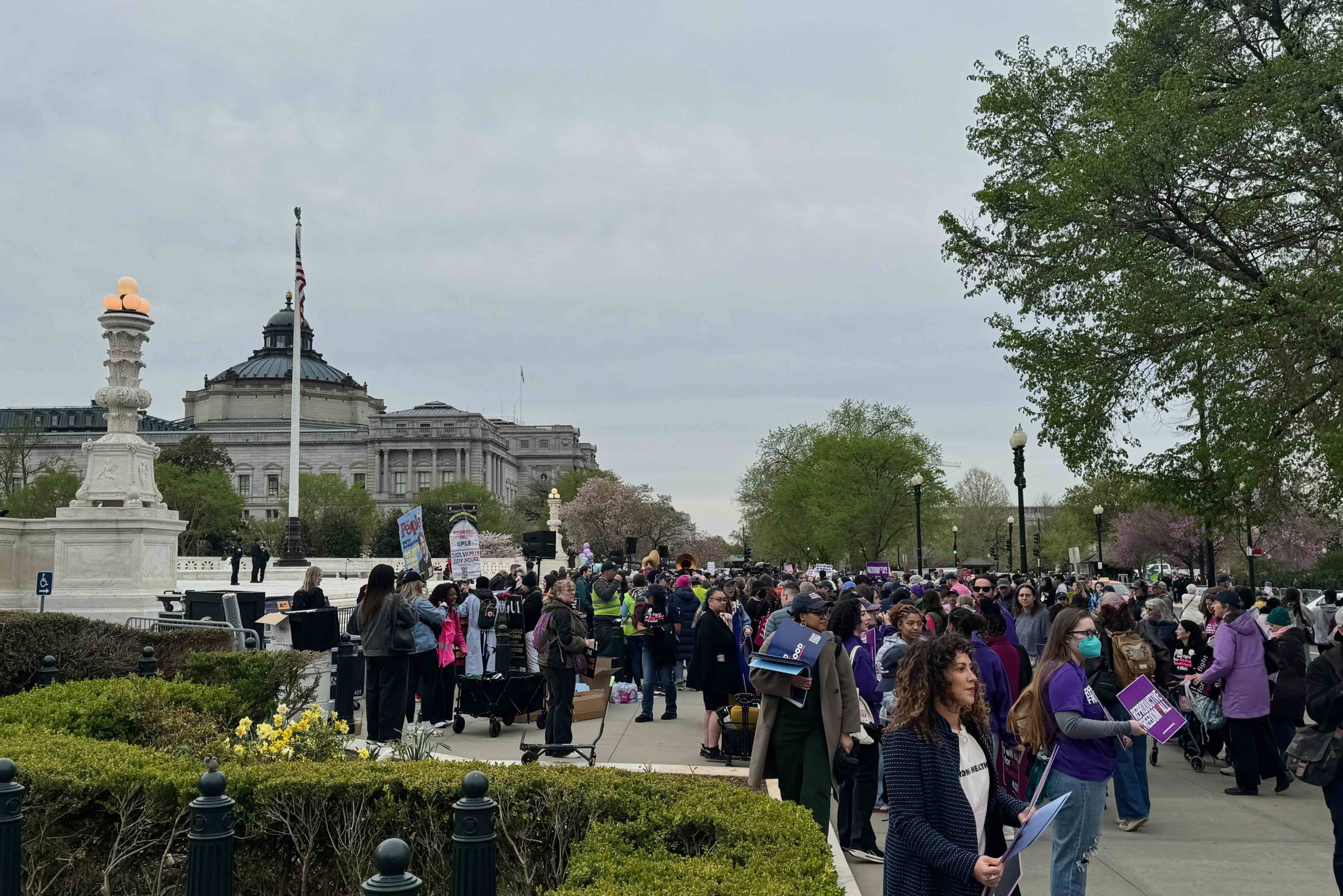
Protesters gather outside the court on Wednesday morning. (Amy Howe)
The Supreme Court on Wednesday was divided over whether Planned Parenthood has a legal right under federal civil rights laws to challenge the order by South Carolina’s governor barring abortion clinics, including Planned Parenthood, from participating in Medicaid.
During more than 90 minutes of oral arguments, the justices struggled to determine whether the Medicaid law on which Planned Parenthood relies must use specific words to signal that Congress intended to create a private right to enforce it – and, if so, what those words might be.
For 60 years, the Medicaid program has provided medical care to more than 72 million Americans of limited financial means. Congress enacted the law pursuant to its power under the Constitution’s spending clause, which allows it to attach conditions to the federal funds that it gives to states.
In 2018, South Carolina Governor Henry McMaster ordered the state’s Department of Health and Human Services to prohibit abortion clinics from participating in the Medicaid program. Federal law generally bars the use of Medicaid funds for abortions. Planned Parenthood provides other medical services, such as gynecological and reproductive care but also screenings for cancer, high blood pressure, and high cholesterol. But because money is fungible, McMaster reasoned, any Medicaid funds that go to clinics where abortion is provided would effectively subsidize “abortion and the denial of the right to life.â€
Julie Edwards, a Medicaid patient in South Carolina who suffers from diabetes and has used Planned Parenthood for birth control, went to federal court in South Carolina along with Planned Parenthood. They contended that McMaster’s order violated a provision of the Medicaid Act that allows any patient who is eligible for Medicaid to seek health care from any “qualified†provider.
The U.S. Court of Appeals for the 4th Circuit agreed with Planned Parenthood and Edwards that the Medicaid Act creates individual rights that can be enforced under federal civil rights laws, and it barred the state from excluding Planned Parenthood from its Medicaid program.
John Bursch, a lawyer for the conservative advocacy group Alliance Defending Freedom, represented the state. He told the justices that for laws enacted pursuant to Congress’s spending clause power, “clear rights-creating language is critical to creating private rights. Congress did not use†such language in the “any qualified provider†provision, he stressed. Indeed, he noted, Congress “knows how to clearly confer a private right to choose a provider†when it wants to do so, as it did in the Federal Nursing Home Reform Act.
Justice Clarence Thomas asked Bursch whether the word “right†is “absolutely necessary in order to determine whether or not a right has been created†under the “any qualified provider†provision.
Bursch answered that “if Congress wants to be clear, ‘right’ is the best word, but we would take its functional equivalent†– for example, “entitlement†or “privilege.â€
Thomas’s question kicked off a debate that continued on and off throughout the morning’s argument: Does a federal law only create a privately enforceable right if it uses specific – or as some justices put it, “magic†– words?
Justice Sonia Sotomayor told Bursch, “You’re not quite calling it a magic word, but you’re coming very close.â€
Bursch countered that what states need is a “clear statement†about their obligations under the Medicaid Act.
But Sotomayor was unconvinced. “It seems a little bit odd,†she suggested, “to think that a problem that motivated Congress to pass this provision was that states were limiting the choices people had.†In light of that history, she posited, it “seems hard to understand that states didn’t understand that they had to give individuals the right to choose a provider.â€
Justice Amy Coney Barrett echoed Sotomayor’s concern about the purpose of the “any qualified provider†provision. If I want to go see the provider of my choice, she said, but the state has disqualified him from participating in Medicaid, “You’re depriving me of my ability … to see the provider of my choice. And nobody’s disputing that†the physician “can provide the services in a competent way that I want to have.â€
Justice Brett Kavanaugh was more supportive of the idea that laws should have to use specific words to create privately enforceable rights. The Supreme Court, he observed, “has failed to give guidance … that lower courts can follow, that states, providers, and beneficiaries can follow.†What words, he asked Bursch, would create such rights, “rather than having something like ‘or its functional equivalent,’ would could†lead to “another decade of litigation�
Bursch suggested that the words “rights,†“entitlement,†“privileges,†and “immunities†would fit the bill. “If you don’t limit it to those few words,†he told the justices, “then all of a sudden, the floodgates are open.â€
Representing the federal government, Kyle Hawkins told the justices that their cases “emphasized that rights-creating statutes are atypical. But†the “any qualified provider†provision, he stressed, “is a run-of-the-mill spending clause statute, and holding otherwise would invite line-drawing problems.â€
Sotomayor pressed Hawkins, observing that the federal government for two decades had contended that the “any qualified provider†provision could be privately enforced through federal civil rights laws. Although the government now contends that it had changed its position after the court’s decision in Health and Hospital Corporation of Marion County, Ind. v. Talevski, holding that nursing-home residents could use federal civil rights laws to enforce two provisions of the Federal Nursing Home Reform Act, Sotomayor suggested that in Talevski the court had simply “reiterated†its analysis in an earlier decision. “Did you need a hit over the head,†she asked, “meaning did you need for us to say it a second time before you understood it?â€
Kagan contended that imposing a “magic words†requirement would be “kind of changing the rules midstream.†Congress, she emphasized, enacted the Medicaid Act a long time ago. “And if we come in now and say you have to use one of these three words,†she noted, it might be useful for future laws, “but it’s not a fair way to interpret statutes that Congress passed many years ago.â€
Unlike Bursch, Hawkins declined to suggest specific words that would create a privately enforceable right. He agreed that words like “right,†“entitlement,†“privilege,†and “immunity†“would count,†but he suggested that “a helpful way to think about it†is that “we’re looking for words that have a real rights-creating pedigree in our nation’s history and legal traditions.â€
But that answer did not necessarily please Kavanaugh, who told him that Kagan had “raised good points about how, once you open it up like that, there are going to be line-drawing problems. You’re not going to solve the issue that you came here to solve.â€
Nicole Saharsky, who represented Planned Parenthood, told the justices that there is no dispute that South Carolina violated the Medicaid Act when it denied Julie Edwards “her choice of a qualified and willing provider.†“The only question,†she said, “is whether she can do something about it, to sue under†federal civil rights laws.
The “any qualified provider†provision, Saharsky maintained, “uses mandatory, individual-centric, rights-creating language. The only thing it doesn’t do,†she said, “is use the word ‘right.’ And this Court has repeatedly said that magic words aren’t required.â€
The justices raised other concerns as well. Barrett questioned whether allowing the 4th Circuit’s ruling to stand would “open the floodgates of people bringing†similar suits, “or is this kind of a pretty unusual circumstance?â€
Hawkins answers that it was “hard to say it’s unusual,†adding that the “any qualified provider†provision was “the most litigated provision†in the statute.
Saharsky pushed back against any idea that a ruling in her clients’ favor would lead to more lawsuits, noting that the 6th Circuit had issued a decision similar to the 4th Circuit’s “more than 20 years ago. If the flood of lawsuits was supposed to happen, we would expect to see it.â€
Moreover, she added, there is no real benefit to Medicaid patients from bringing lawsuits to challenge the denial of their provider of choice. Money damages are not available, she noted. “These aren’t people getting rich,†she said. “They’re just trying to get healthcare here.â€
Kavanaugh voiced what he characterized as a “broader separation-of-powers concern†– the idea that “Congress creates rights of action and remedies, not the Court.†For more than two decades, Kavanaugh told Saharsky, the Supreme Court had “really tightened up†on creating causes of action, “and said essentially that far and no further.â€
Saharsky countered that this dispute involves “an express cause of action†under the federal civil rights laws, so there is no need for the court to create one. And she conceded that there “is a high bar to find that Congress put in place an individually-enforceable right. What we’re saying is that this provision meets the bar.â€
Justice Samuel Alito was similarly skeptical, describing it as “quite extraordinary†for the court to find that a law enacted pursuant to Congress’s spending clause power creates a privately enforceable right of action. And if a federal civil rights lawsuit can follow “whenever Congress uses the word ‘individual,’†he told Saharsky, “then all sorts of provisions could give rise to†liability. “Congress,†he said a few minutes later, “may well have had in mind†that the state needs to provide Medicaid beneficiaries with the ability to choose their own qualified health-care providers, “but not that this is something that allows an individual to sue in court.â€
In his rebuttal, Bursch argued that “the fact that the 12 of us can have such a robust conversation about whether this statute is mandatory or not, whether it’s rights-creating or not, demonstrates that the rights-creating language is ambiguous, not clear and explicit. And if there is any ambiguity in this context,†he concluded, “the state has to win because it’s not being put on notice of when it might be sued.â€
A decision is expected by summer.
This article was originally published at Howe on the Court.Â
[ad_2]
Source link